When Noise Becomes Strategy: The Hidden Economics of Repeat Claims and Performative Certainty.
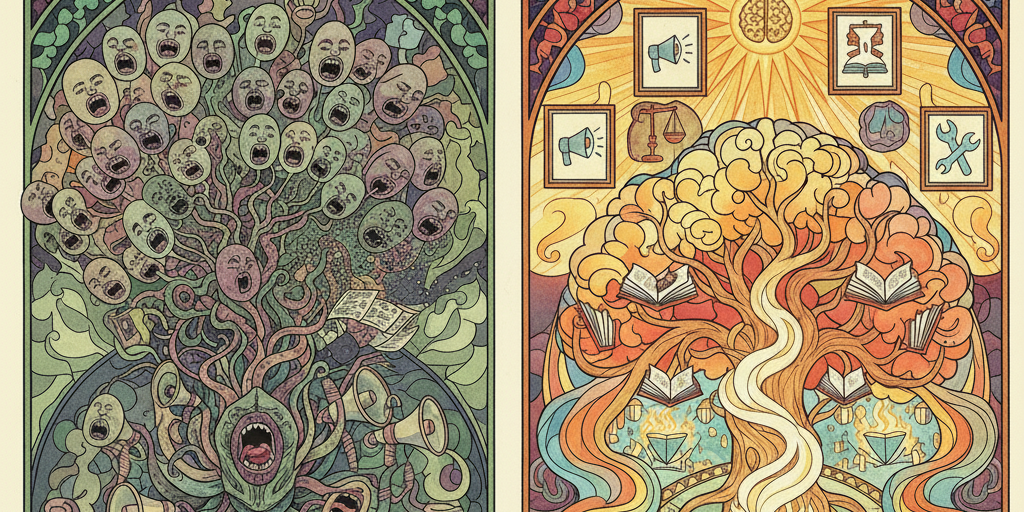
How repetition and performative positivity turn uncertainty into false conviction and what teams can do this week to reverse it. Four practical moves that restore signal, accelerate learning, and make failure a source of insight rather than shame.
Why are we so terrified to admit what actually failed, yet so quick to believe a "fact" we've just heard three times?
What if everything you’re hustling to scale is only convincing you that it mattered?
What if the ideas you defend most fiercely are just echoes you've heard too often, drowning out the truths that could set you free?
Repetition as principle: the illusory-truth economy
We live in a world that runs on repetition. We’re told that moon rock has the same density as cheddar cheese. We hear it from a blog, then a friend, then a tweet. Suddenly, this fiction feels more real than our own experience. We start repeating it.
This is the air we breathe. It’s the engine of propaganda, the secret of advertising, the reason fake news spreads. It’s the illusory truth effect: hearing something feels like knowing it.
At the same time, when a real, concrete project fails, when something we poured our energy into simply dies. We're told to "find the opportunity," to "fail forward," to spin the loss into a win. We're expected to just keep a positive head while the loss sits like a stone in our gut, unacknowledged.
We live in a culture that confuses volume for value. Teams chase the fiction of “universal demand” while the truth is granular: some people will care, most will not, and pretending otherwise wastes focus.
How repetition reshapes workplace conversation and signal
Conversations at work collapse into performance, louder opinions, not clearer thinking, because nobody agreed how to engage. Repetition does the rest: ideas repeated enough stop being questioned and start being treated as facts.
Meanwhile, the losses you refuse to name simmer under the surface: projects quietly abandoned, trust eroded, lessons unclaimed. That combination of mistaken scale signals, unregulated debate, unquestioned repetition, and un-mourned failure, is not benign. It’s the slow rot that makes good teams mediocre and good work irrelevant.
In this relentless stream of opinions and ads, we cling to notions that feel solid simply because they've bombarded us repeatedly like that viral "fact" about moon rocks matching cheese density, slipping into our minds unchallenged.
We jump into debates without pausing to consider if we're the one who should lead the charge or step back to learn, blurting out half-baked thoughts that clash uselessly.
Meanwhile, we chase universal appeal for our work, ignoring that real impact starts with a niche few who truly resonate, not some mythical crowd. And beneath it all lingers the sting of setbacks we've buried alive, like a startup flop where we poured our soul, only to plaster on fake optimism and soldier on, pretending it didn't gut us.
Emotional and organisational deterioration
This mismatch is crushing us. We become hollow, participating in gossip about a new manager we barely know simply because the story has been repeated. We get stuck, wondering why we can't move on, not realising we're still carrying the ghost of a failure we were never allowed to grieve.
This is why our disagreements are so toxic. We just blurt out whatever we think, arguing over "facts" that are just illusions and defending positions we don't even own. We flail in our conversations, not knowing if we're supposed to be the teacher, the student, or just a peer. We are building on sand, and we are exhausted from pretending it's rock.
This is not merely inefficiency; it metastasises. Resources pour into initiatives built for an imagined “everyone.” Meetings become gladiatorial stages where credibility is assumed, not calibrated. Stories that have been repeated become truths nobody verified. People stop learning because admitting a mistake means losing status rather than recovering insight.
The emotional tax is real: fatigue, diminished curiosity, fear of speaking up, and a creeping cynicism where signals of real opportunity are drowned by the noise of performative certainty. Over time the organisation becomes excellent at justifying its past choices and terrible at making new ones.
This tangled mess erodes us quietly at first, then viciously, false convictions steer us toward dumb purchases or toxic alliances, wasting years on illusions that propaganda peddles as gospel.
Arguments devolve into ego battles, fracturing teams and stalling progress because no one calibrates their voice to their actual expertise, leaving the less informed shouting over the wise. By fixating on pleasing everyone, we dilute our creations into bland oblivion, missing the spark that could ignite real change, while scale chases us like a false god.
Worst of all, those unmourned defeats fester, blocking fresh starts; they trap us in hesitation, replaying old pains in silence, sapping our drive until we're just going through motions, haunted by what we refuse to grieve.
A humane corrective: mourning, role clarity, and skepticism
The escape isn't another 10-point plan. It's a fundamental, human shift. What if, instead of spinning, we mourned? What if, when a company we invested in collapsed, the partners got together to honor the loss, put aside reputation, and put their humanity first? This is how recovery begins. This is how we learn.
And what if we applied this brutal honesty to our conversations? What if we stopped blurting and started asking: Am I the one who knows more here, or do they? Should I be teaching, or should I be asking questions? The breakthrough is realising that getting the balance right between our assertiveness and our open-mindedness, based on our actual levels of understanding, is the only way to cut through the noise.
These are not soft niceties. They are instruments for clearer signal, faster learning, and safer experimentation. When you stop pretending the crowd defines value, when you enforce rules of engagement based on believability, when you treat repeated claims as hypotheses rather than facts, and when you publicly grieve failures to extract their lessons, you create the conditions where productive risk returns.
Practical enactment and behavioural shifts
Start by confronting those repeated "truths" head-on, verifying them before they take root, turning skepticism into your sharpest tool against the noise. Shift how you engage. Gauge if you're teaching from hard-won knowledge, probing as a curious learner, or sparring as equals, always tuning your boldness to what you truly grasp. Ditch the everyone-obsession; hunt for those specific allies who crave what you offer, letting their passion fuel the momentum before any grand expansion.
And crucially, face the losses square: gather your circle, drop the facades, and let the raw ache flow. Mourning not as weakness, but as the ritual that clears the debris, unlocking swift lessons and bold pivots.
Vision: a team that learns and the four moves
Imagine a team that isn't stuck. A team that learned its lessons instantly from a catastrophe because they processed it. A culture that holds "Days of the Dead" for failed experiments, making space for the new.Imagine conversations where you aren't fighting, but building, because everyone understands their role.
This is how you find clarity. This is how you stop trying to convince "everyone" that imaginary, exhausting trap and start finding the right somebodies. Because when you're operating from a place of earned belief and processed failure, scale is no longer the signal you're looking for. Impact is.
Stop. Find the failure you haven't mourned.That's your starting point.
Imagine a team that builds for the small set of people who truly matter, argues with rules that sharpen insight instead of bruising relationships, refuses the comfort of repeated falsehoods, and treats failure as fuel rather than shame. Meetings end with decisions and learning, not theatrical victories. Experiments fail fast, lessons are harvested, and confidence grows from verified wins, not repeated slogans.
Picture emerging clearer-eyed, where your beliefs stand on rock-solid ground, fueling decisions that propel you forward without the drag of deception. Collaborations hum with purpose, debates sharpen ideas instead of egos, and your work lands with precision on those who amplify it, building authentic growth that endures.
If you want that, start with four concrete moves this week:
- Name one “right somebody”: pick a specific audience and stop pretending the product or message is for everyone.
- Declare roles before debate: for the next decision, state who is the teacher, who is the student, who is the peer.
- Test a repeated claim: choose one widely accepted assertion in your work and design one quick experiment or a disconfirming search.
- Mourn one failure publicly: share what you lost, what you felt, and what you learned.
Do these four things and you will shorten the distance between intent and impact. Do nothing and the machinery of repetition, misplaced certainty, and unprocessed loss will keep turning, quietly stealing future options. Choose what you want your work to be judged by: the applause of a crowd you never served, or the durable value felt by the people who truly matter.
The Essential Concepts
Core Problem: The Illusory-Truth Economy
The core issue is that repetition and performative positivity function as a strategy—the Illusory-Truth Effect—which turns uncertainty into false conviction and stifles learning.
- Illusory Truth Effect (Diagnosis): The psychological phenomenon where simply hearing something repeatedly makes it feel more real and true, regardless of evidence. This confuses volume for value and allows ideas repeated enough to be treated as facts.
- The Unacknowledged Loss: The cultural expectation to "fail forward" and spin losses into wins means failures are never allowed to be mourned or processed. The un-mourned loss sits unacknowledged, leading to unclaimed lessons and preventing recovery.
- Mistaken Scale Signals: Teams chase the fiction of “universal demand” ("everyone") while the truth is that real impact starts with a niche few ("the right somebody"). Pretending otherwise wastes focus.
The Humane Corrective: Ritual, Roles, and Skepticism
The solution is a fundamental, humane shift focused on restoring signal, accelerating learning, and making failure a source of insight.
- The Mourning Ritual (Learning Framework): A necessary, human shift where individuals and teams convene a real ritual to mourn what was lost (e.g., a collapsed project, a failed investment). This is how recovery begins and lessons are learned, preventing slow rot and restoring agency.
- Role Clarity in Debate (Engagement Framework): To cut through the noise, conversations must move beyond aimless blurting. Before debate, participants must declare explicit roles based on actual expertise: Who is the teacher? Who is the student? Who is the peer (challenger)? This allows relative expertise to shape who asks and who asserts, preventing toxicity.
- The Skepticism Discipline: Consciously combat the repetition trap by treating widely accepted, repeated claims as hypotheses rather than facts. This requires deliberately seeking disconfirming evidence to prevent performance from replacing clarity.
- Focus on the Right Somebody (Audience Principle): Orient decisions around a specific audience rather than an impossible "everyone." This ensures effort is directed toward durable value and impact, not applause from a crowd never served.
Four Moves to Reverse Noise and Restore Signal
To shorten the distance between intent and impact and prevent the machinery of repetition from stealing future options, execute these four concrete moves this week:
- Name one “right somebody”: Pick a specific audience (a specific customer profile, a key decision maker) and stop pretending the product or message is for everyone.
- Declare roles before debate: For the next important decision or contentious conversation, explicitly state who is the teacher, who is the student, and who is the peer.
- Test a repeated claim: Choose one widely accepted assertion in your work (a "fact" everyone repeats) and design one quick experiment or conduct a disconfirming search to check its validity.
- Mourn one failure publicly: Share what you lost, what you felt, and what you learned from one significant failure you have previously ignored or spun into a positive.
I am a Knowledge Worker...
What does it mean for me?
You are operating within an Illusory-Truth Economy where ideas repeated by colleagues or senior leaders are treated as facts, regardless of evidence.
This Repetition Trap stifles learning and accelerates Mistaken Scale Signals, causing your team to chase the fiction of "universal demand" for projects that truly matter only to a niche audience, the "right somebody."
Furthermore, the pressure to "fail forward" creates Unacknowledged Loss, leaving crucial lessons unclaimed and fostering a creeping cynicism that drains curiosity and erodes morale.
Your breakthrough is the Humane Corrective, which restores signal by enforcing Role Clarity in Debate (using actual expertise to shape conversation) and practicing the Skepticism Discipline to challenge repeated assumptions.
By introducing a Mourning Ritual for failure and focusing on the Right Somebody, you can accelerate learning, restore psychological safety, and ensure your contribution leads to durable value instead of theatrical victories.
How do I action this?
- Declare Roles Before Debate (Role Clarity in Debate): Before your next important internal decision or contentious discussion, explicitly declare the primary role for yourself and the other key participant based on actual expertise (e.g., "I'm the student; I will ask questions for the first 10 minutes," or "I'm the teacher; I will assert the first conclusion"). This ensures relative expertise shapes the exchange.
- Test a Repeated Claim (Skepticism Discipline): Identify one widely accepted assertion in your current project (a "fact" everyone repeats, e.g., "The client base is only on Platform X"). Design one quick experiment (e.g., run a 1-hour disconfirming search for Platform Y usage, or send a micro-survey) to test the validity of this repeated claim.
- Mourn One Failure Publicly (Mourning Ritual): Identify one significant failure (a quietly abandoned project, a mistake you minimised) that has an unclaimed lesson. In a small, safe setting (e.g., a 1:1 with your manager or a trusted peer), share what you lost, what you felt, and the one critical thing you learned to practice the Mourning Ritual and recover insight.
- Name the Right Somebody (Audience Principle): For your current primary work output (a report, a feature, a presentation), name one specific decision-maker or customer profile that you are exclusively serving (your "right somebody"). Use this narrow focus to ruthlessly cut out any content designed to appease the mythical "everyone."
I am a Freelancer, Solopreneur, Entrepreneur, Independent Worker...
What does it mean for me?
Your path to sustainability is being hijacked by the Illusory-Truth Economy, where you internalise and repeat market "facts" simply because they are loud and popular online, leading to false conviction.
This is exacerbated by Mistaken Scale Signals, you chase a mythical, universal audience when real traction requires focusing on "the right somebody."
You are also at risk of Unacknowledged Loss by feeling pressure to always "hustle" and spin any client or product failure as a win, preventing you from learning the brutal, necessary lessons.
Your antidote is the Humane Corrective. By applying the Skepticism Discipline to your market assumptions and enforcing Role Clarity in your internal planning (e.g., with advisors), you can build a culture of earned belief and use the Mourning Ritual to turn setbacks into fuel for your next, more successful, attempt.
How do I action this?
- Declare Roles Before Debate (Role Clarity in Debate): Before your next important conversation with a mentor, advisor, or co-founder, explicitly declare the primary roles for the discussion (e.g., "You are the teacher; I'm the student, and I need you to challenge my pricing," or "We are peers; let's spar on the product name"). This ensures the conversation delivers clear signal, not just aimless chatter.
- Test a Repeated Claim (Skepticism Discipline): Choose one widely accepted assertion about your niche (e.g., "Clients only use X tool," or "Pricing must be low to start"). Design one quick experiment (e.g., a targeted disconfirming search on a forum, a poll, or a direct pricing test) to check the validity of this repeated claim and build your strategy on evidence.
- Mourn One Failure Publicly (Mourning Ritual): Identify one significant failure (a botched launch, a bad client experience, a failed product idea) that you previously tried to "spin." Write a short "Day of the Dead" note documenting what you lost, what you felt, and the one core insight. Share this note (e.g., to a trusted peer group or in a private journal) as a Mourning Ritual to clear the emotional debris.
- Name the Right Somebody (Audience Principle): Pick one specific, highly defined customer profile (your "right somebody") who would pay for your current offering. Immediately stop all marketing or product development efforts aimed at the broader "everyone," and focus every action this week on solving that one profile's most acute pain point.