The Illusion of Truth by Repetition: Why Easy Ideas Win and How to Make Hard Ideas Processable.
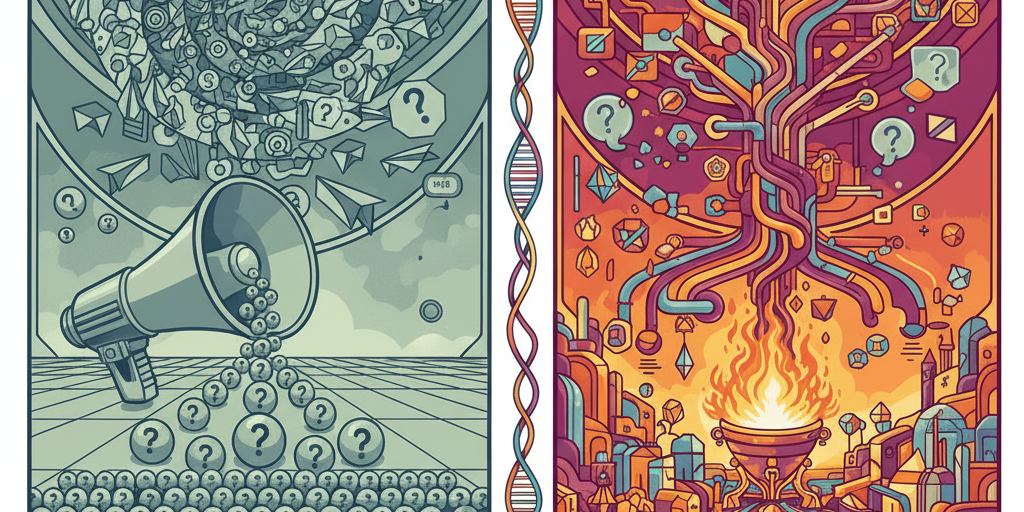
When ease of processing outcompetes originality, repetition becomes the dominant currency not truth. This essay diagnoses the cognitive mechanism behind market sameness and prescribes practical practices (confidence tags, “perhaps,” and deliberate friction) to make novel ideas land.
Have you ever had a brilliant, original idea, only to watch the world shrug and embrace the same tired, obvious "truth"?
What if your greatest asset (certainty) is quietly turning your work into a copy of everyone else’s?
What if the very certainty that keeps you comfortable is the silent thief stealing your future?
The Paradox of Certainty: The Marketplace and the Brain’s Shortcut Mechanics
The world feels like a crowded marketplace. You’ve reinvented yourself, you’ve put in the work, but when you look around, it feels like everyone else had the same idea at the exact same moment.
You struggle to answer the simple questions: "What do you specialise in?" "How are you different?" The terrifying silence that follows is the realisation that if you can't articulate your unique value, no one else will do it for you. But this isn't just a marketing problem. It's a biological one.
The real threat isn't just the competition; it's that the human brain, which consumes 20% of our body's energy, is fundamentally designed to conserve that energy. Thinking is hard work, and our brains are wired to take the easy path.
Most of us live inside tidy answers. We choose the obvious path because it’s faster to explain, easier to sell, and feels safe. That comfort flattens inquiry.
Repetition whispers authority: a repeated sentence becomes easier to process, and because our brains conserve energy, ease feels like truth. Small design choices make ideas feel truer than they are: legible text, a catchy rhyme, the same slide deck everyone uses.
The result is a market of near-identical offerings and a culture that prizes confidence over calibrated uncertainty. People nod at familiar advice; they rarely ask whether the advice fits them. Meanwhile, the real problem grows: when everyone defaults to the safe answer, differentiation evaporates and meaningful progress stalls.
The “obvious” answers are celebrated, where the familiar feels safe and the unfamiliar is dismissed. That comfort comes at a price: ideas stop being questioned, and the relentless hum of repetition convinces us that the loudest voice is the truest.
The brain, ever‑hungry for efficiency, latches onto the easiest‑to‑process thoughts (rhyme, bright colours, familiar phrasing) and treats them as facts. Over time, this illusory truth effect builds a wall of unquestioned assumptions, turning curiosity into complacency. The result? Decisions made on half‑truths, strategies that echo yesterday’s headlines, and a collective drift toward mediocrity.
The Cognitive Bias: Illusory Truth and Processing Fluency
This "energy-saving" mode has a devastating consequence: the illusory truth effect. Because processing new, complex ideas is metabolically expensive, our brains default to what's easy. We mistake cognitive fluency for factual accuracy. This is why your novel, complex, valuable idea gets ignored, while a shallow, catchy slogan wins the day.
This is not an opinion; it's a documented bias. Research shows we are more likely to believe a statement simply because it's been repeated, even if it’s false. We judge aphorisms as more accurate if they rhyme. We even find statements more credible if they are presented in an easy-to-read colour.
Your groundbreaking insight doesn't rhyme. It isn't "easy." And so, it's subconsciously processed as less true. Your potential is being suffocated by the world's deep-seated preference for the familiar. This isn’t just theoretical.
Costs: Emotional, Commercial and Organisational Fallout
The emotional price is real: frustration at being ignored, the slow hollowing of creative ambition, the quiet anxiety of watching opportunities slip to those who dared to be distinct. Commercially, it means commoditised roles, shrinking margins, and wasted effort pitching versions of what already exists. Intellectually, it breeds hubris. Assertions presented as fact without a clear signal of confidence.
When teams hide their uncertainty, decisions ossify; when leaders overstate conviction, the organisation commits to brittle plans. Add the cognitive illusion that repetition breeds truth, and you get entire strategies propped up by familiarity rather than evidence. The longer this continues, the harder it becomes to unlearn it.
Every day that we accept the “obvious” without probing, we pay in wasted potential. Projects stall because teams never surface dissenting views; markets shift while leaders cling to stale playbooks; personal growth stalls as we repeat the same self‑talk that once soothed us but now shackles us.
The hidden cost is not just missed opportunities. It’s the erosion of confidence in our own judgment, the fatigue of fighting an invisible enemy that thrives on our mental shortcuts, and the creeping dread that we’re merely passengers on a train whose destination we never chose.
Prescription: "Perhaps", Confidence Labels and Deliberate Friction
What if we've been fighting the wrong battle? We don't need to be louder; we need to be clearer. The breakthrough isn't about dumbing down your ideas. It's about understanding the "energy cost" of your message and learning to package originality in a way that the brain will accept. You must stop competing in the arena of the "obvious." As Seth Godin notes, "Obvious" closes the door to inquiry. It’s a dead end.
Our path forward lies in the power of "Perhaps." "Perhaps" is an invitation. It's the start of a conversation, not the end. It's the courage to articulate, as Ray Dalio argues, the exact level of your confidence to distinguish your "suggestion" from your "firmly held conviction," and to show the track record that gives you the right to say it. You don't fight the brain's bias; you respect it by providing a clear, new path.
Counterintuitive as it sounds, the cure begins by valuing the awkward, the tentative and the explicitly uncertain. Start declaring how confident you are. Label suggestions as suggestions and convictions as convictions. Treat “perhaps” as a design principle: it invites exploration; it keeps options open.
Deliberately break processing fluency when you want scrutiny. Change the frame, vary the medium, or present the same claim in an unfamiliar form so it must be reconsidered. Reinvention isn’t a one-off stunt; it’s a practice.
When your career or company feels identical to others, the solution is to experiment in adjacent spaces, to borrow skills from different domains, and to iterate until something distinct holds up. That posture "transparent about confidence, disciplined about testing, and restless about sameness" creates an honest advantage.
Imagine a space where suggestions are labeled as suggestions, convictions as convictions, and every claim is accompanied by a confidence score. By adopting Ray Dalio’s practice of explicit confidence ratings, we force the mind to confront uncertainty head‑on.
Pair that with Seth Godin’s invitation to replace “obvious” with “perhaps,” and you create a habit of opening doors instead of closing them. The key weapon is deliberate friction: pause, ask “what if this is wrong?” and test the answer against evidence, not repetition. This intentional slowdown rewires the brain’s shortcut circuitry, making processing fluency a tool for discovery rather than deception.
Vision and the Plan
This is the moment you stop being invisible. Imagine confidently articulating what you bring to the table, not as a desperate plea, but as a clear, undeniable fact. This is a future where your ideas don't just get heard; they get acted upon. You are no longer just another consultant, another employee, another voice in the crowd.
You are the one people seek out because your insights are different, valuable, and finally understood. You have figured out how to make originality resonate. Are you ready to stop being "obvious" and start being heard?
Imagine work where every proposal carries a confidence tag, every repeated idea is tested in a new form, and your offering is recognisable not because it echoes the market but because it refuses to. You win clients who value original thought; you build teams that prefer inquiry to comfortable consensus; you conserve creative energy by investing it where novelty actually matters.
Picture a community where ideas are vetted with transparent confidence, where the echo chamber is broken by purposeful doubt, and where each decision feels earned, not inherited. Teams move faster because they know exactly where belief ends and speculation begins; individuals reclaim the thrill of genuine insight, no longer haunted by the ghost of repeated myths.
The path forward is simple: start today by labeling every opinion with a confidence level, and whenever you catch yourself defaulting to “obvious,” replace it with “perhaps.”
Do one concrete thing today: pick your next three claims and append a confidence level to each (“low,” “medium,” or “high”) and beside each, write one small experiment that would raise or lower that level within a month.
If that feels unfamiliar, good. That discomfort is the first sign you’re no longer rehearsing familiar lines. Walk through it deliberately. Perhaps is where growth begins; obvious is where the conversation ends. Watch the ripple turn complacency into curiosity, and watch your world reshape itself around the possibilities you dare to entertain.
The Essential Concepts
Cognitive Shortcut Mechanics
The primary challenge is a biological and market paradox: the human brain is wired to conserve energy, mistaking cognitive fluency (ease of processing) for factual accuracy.
- Processing Fluency (Diagnosis): Thinking is metabolically expensive. Our brains prioritise what's easy. Because a repeated sentence becomes easier to process, this ease is mistakenly interpreted as truth or authority. This is the engine behind advertising and the spread of fake news.
- The Illusory Truth Effect (Cognitive Bias): A documented bias where people are more likely to believe a statement simply because it has been repeated, even if it's false. Small design choices (e.g., legible text, rhyme, familiar phrasing) make ideas feel truer than they are.
- The Paradox of Certainty: Certainty (choosing the obvious, safe path) flattens inquiry and allows differentiation to evaporate. When everyone defaults to the safe answer, meaningful progress stalls.
- Cost: This leads to commoditised roles, shrinking margins, and wasted effort on near-identical offerings. Emotionally, it causes the slow hollowing of creative ambition and frustration at being ignored.
Packaging Originality for Acceptance
The breakthrough is not to be louder, but to be clearer by understanding the "energy cost" of your message and packaging originality in a way the brain will accept.
- The Power of "Perhaps" (Inquiry Principle): Replace the closing statement of the "obvious" with "Perhaps." This word serves as an invitation to exploration and the start of a conversation, keeping options open (as noted by Seth Godin).
- Confidence Tags (Dalio's Discipline): A practice (based on Ray Dalio's work) of explicitly articulating the exact level of your confidence for every claim (e.g., "suggestion," "firmly held conviction," "low," "medium," or "high"). This forces the mind to confront uncertainty head-on and distinguishes earned insight from mere assertion.
- Deliberate Friction (Reconsideration Tactic): Counterintuitive as it seems, deliberately break processing fluency when you want scrutiny. This can be done by changing the frame, varying the medium, or presenting the same claim in an unfamiliar form so the brain must pause and reconsider it.
Minimal Action for Originality
To stop being "obvious" and start making your originality resonate, the path forward requires transparent uncertainty and disciplined testing:
- Label Claims with Confidence: Pick your next three professional claims and append a confidence level to each ("low," "medium," or "high").
- Design Experimentation: Beside each claim, write one small experiment that, if executed, would raise or lower that confidence level within a month.
- Replace Comfort with Inquiry: Whenever you catch yourself defaulting to “obvious,” replace it with “perhaps.”
I am a Knowledge Worker...
What does it mean for me?
You are constantly battling the cognitive reality of Processing Fluency within your organisation.
Your original, complex insights are often ignored not because they are wrong, but because they are metabolically expensive to process, while familiar, safe ideas win due to the Illusory Truth Effect.
This creates a Paradox of Certainty—your team's collective comfort with the "obvious" path flattens inquiry, causes differentiation to evaporate, and results in your work becoming commoditised.
The commercial and emotional cost is real: frustration and the slow hollowing of creative ambition.
The key to career growth is adopting Confidence Tags and the Power of "Perhaps" to package your originality.
By making your level of uncertainty explicit, you bypass the brain's shortcut mechanics and force stakeholders to confront your nuanced reasoning, transforming ignored insight into actionable strategy.
How do I action this?
- Label Claims with Confidence (Dalio's Discipline): For your next three key assertions in a meeting or document (e.g., a timeline estimate, a risk assessment, a feature recommendation), explicitly append a Confidence Tag (e.g., "High Conviction: 85%," "Suggestion: Low Confidence"). This makes your uncertainty transparent and forces the mind to engage with the reasoning.
- Design Experimentation (Raise Confidence): For those three labeled claims, write one small, rapid experiment (e.g., a 2-hour data pull, a 15-minute stakeholder interview) that, if executed, would raise or lower that confidence level within a month. Present these small experiments as the next step, replacing comfortable assertion with disciplined testing.
- Replace Comfort with Inquiry (The Power of "Perhaps"): For the rest of the week, whenever you or a colleague defaults to an opinion or conclusion that feels like the "obvious" answer, immediately interject by reframing the idea with the Power of "Perhaps" (e.g., "Instead of 'This is the market standard,' try, 'Perhaps the market standard is worth questioning here'").
- Introduce Deliberate Friction (Reconsideration Tactic): For one recurring presentation or report that is overly familiar to your audience, present the core data in an unfamiliar form (e.g., vary the medium, use a counter-intuitive visual, or change the narrative frame entirely) to introduce Deliberate Friction and force the brain to pause and reconsider the content.
I am a Freelancer, Solopreneur, Entrepreneur, Independent Worker...
What does it mean for me?
The market is punishing your originality due to Processing Fluency: your unique value proposition is metabolically expensive for potential clients to process, while the shallow, familiar options win via the Illusory Truth Effect.
Your Paradox of Certainty—sticking to "obvious" business paths or marketing tropes—is causing your unique selling proposition to evaporate, leading to commoditised roles and shrinking margins.
The emotional cost is the slow hollowing of creative ambition as your work is repeatedly ignored.
The solution is to package your originality using Confidence Tags and the Power of "Perhaps". This Deliberate Friction counters the brain's shortcut mechanics, making your original ideas clear, undeniable, and finally accepted as true by clients who value integrity and expertise.
How do I action this?
- Label Claims with Confidence (Dalio's Discipline): In your next three client pitches or marketing claims (e.g., estimated ROI, a timeline, a niche definition), explicitly append a Confidence Tag (e.g., "Firmly Held Conviction based on X data," or "Initial Suggestion, Confidence Low until tested"). Use this transparent approach to build credibility.
- Design Experimentation (Raise Confidence): For those three labeled claims, write one small experiment (e.g., a micro-A/B test on a landing page, a targeted cold email campaign) that would raise or lower that confidence level within a month. Commit to running this experiment instead of spending money on broad, untargeted marketing.
- Replace Comfort with Inquiry (The Power of "Perhaps"): When articulating your offering this week, replace all closing statements (e.g., "This is the best solution") with the Power of "Perhaps" to invite inquiry (e.g., "Perhaps this structure provides the best leverage for your current team"). This opens the door to conversation and signals original thought.
- Introduce Deliberate Friction (Reconsideration Tactic): In your primary online communication channel (e.g., newsletter, social media), present one of your core ideas in an unfamiliar form this week (e.g., use an unusual comparison, a completely different visual style, or vary the medium from text to audio). This Deliberate Friction forces your audience to pause and re-engage with your claim.