Manufactured Familiarity: The Attention Economy That Manufactures the "Self" You Keep.
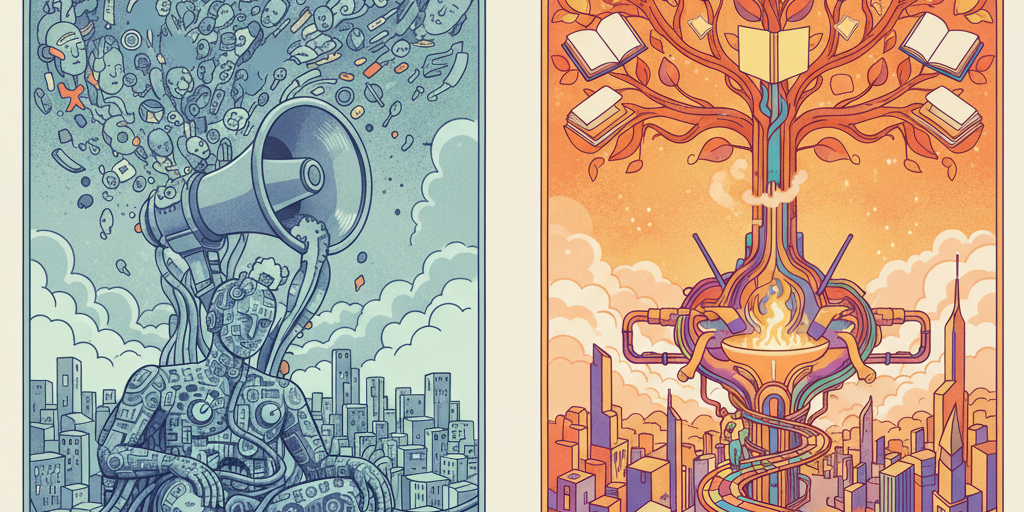
How repetition and volume shape who you become and why “being yourself” is no remedy. A diagnostic of attention economies and a compact blueprint to design the self and signals that actually cut through. When culture amplifies the default, hard work follows the wrong direction. Stop competing with noise: deliberate identity design, smaller signals, measurable cultural levers.
When you’re told to "just be yourself," which self are they talking about? The self you were at 20? The self you are after a long night? The self who is almost out of diapers?
What if the reason your best ideas never land isn’t talent, time, or luck but the way you and everyone around you are being trained to believe?
What would happen if the story you’ve been telling yourself about who you are is the very script that keeps you invisible?
The Attention Economy: The Firehose of Propaganda
We’re all drowning. We're living inside a “firehose of propaganda,” a relentless, high-volume, multi-channel assault on our attention. It’s not just political; it’s the endless stream of corporate agendas, social "shoulds," and algorithm-fed “truths.”
This flood is rapid, continuous, and repetitive. It makes no commitment to objective reality or even consistency. It doesn't have to. Through sheer, deafening repetition, it creates a "quasi-truth" that we passively absorb.
This manufactured noise becomes our environment. It becomes the "culture" that quietly determines the kinds of people we're "allowed" to be. We stop shaping our world; it starts shaping us.
We call this age “connected,” yet connection has been hollowed into repetition. Powerful institutions and attention merchants no longer persuade by evidence; they persuade by volume. Repeating an image or a slogan until it feels familiar now substitutes for reasoning.
Historic propaganda taught this lesson with bold posters and a single clear pose; today’s equivalent is a relentless, multi-channel avalanche that drowns nuance and rewards the loudest echo.
At the same time, organisations still behave like machines with interchangeable parts: people slot into roles and culture is treated as wallpaper. But culture and the people inside it shape each other. Hire for a default, and you get the default amplified.
Individually, we are given the platitude “be yourself” as if identity were fixed. A better question is: which version of yourself will you become if you want to matter? Many of us keep working hard, diligently but on the wrong currents, assuming effort equals influence.
Most of us drift through days wrapped in familiar comforts: a routine job, a curated feed, a circle of voices that echo what we already believe. Yet beneath that veneer lies a subtle erosion: we’re performing versions of ourselves that were never truly ours.
Seth Godin asks us to “be yourself,” but which self? The toddler still clinging to a blanket, the fan screaming at a stadium, the exhausted night‑owl? The answer is rarely honest. We settle for a persona that fits the expectations of a culture we’ve inherited, not the one we’d proudly own.
Ray Dalio reminds us that an organisation is a machine of culture and people, each shaping the other. In our personal “organisation,” the culture of endless comparison, click‑bait headlines, and relentless productivity metrics molds us into compliant cogs. The result? A collective identity that feels safe but is fundamentally hollow.
Consequences: Paralysis, Mistrust, and The Erosion of Expertise
The result isn't just confusion; it's paralysis. We feel perpetually busy but fundamentally ineffective. We become like the clients Dorie Clark describes: working hard, but on the wrong things.
Why? Because it’s easier. We keep focusing on what we're good at, or what’s comfortable, the "self" the firehose has reinforced. We can't even describe what we do with any power. We offer the plain vanilla version: "I'm a consultant," or "I'm a manager." It's true, but it's hollow.
This saturation of noise does more than waste our potential. It actively nudges us toward paranoia and mistrust. We begin to trust the familiar, repeated lie more than a new, complex truth. Familiarity breeds a false sense of trust, and we lose our grip on our own first impressions, our own instincts.
The consequence is practical and moral. Expertise becomes diluted; trust erodes; decisions shift from reasoned to reflexive. Teams burn hours polishing the visible parts of a machine while its core keeps rusting.
Careers plateau because visibility replaces value; good work goes unseen while louder, emptier messages set the agenda. Emotionally, people feel disoriented: resentment toward authority, suspicion of experts, and the slow despair of repeated small defeats. Social attention becomes a resource you can’t mine without poisoning the ground for future harvests.
When propaganda masquerades as information, repeating half‑truths until they become quasi‑truths, we surrender our capacity to discern. Shane Parrish shows how the “firehose of propaganda” drowns out nuance, feeding paranoia, mistrust, and a quiet contempt for expertise.
The cost isn’t just a misinformed opinion; it’s a growing numbness to our own aspirations. Every day we spend hours polishing a résumé that mirrors someone else’s success, we trade authentic ambition for a rehearsed performance.
The hidden toll is a gnawing emptiness, a sense that our best ideas are muffled by the noise we helped amplify. Dorie Clark captures it perfectly: brilliant minds are lost in a crowded, noisy world because they’re stuck on the wrong things.
A Constructive Reframing: Authenticity as Engineered Identity
What if "be yourself" is a trap? The real breakthrough is realising that authenticity isn't something you find. It’s something you build. As Seth Godin challenges, how about this: Become the self you’d be proud to be.
This is the ultimate act of rebellion. It’s the conscious decision to stop being a passive receptacle for the firehose. It’s the realisation that you must deliberately hang out with people and ideas that help you become that self. You must design the "culture" of your own life, knowing that it, in turn, will build the person you’re choosing to become.
There is a precise counter-logic embedded in the very authorities that helped diagnose the problem.
First: choose deliberately who you are becoming, not some childhood notion or a default label, but the version of you you would be proud to embody. Live that identity in small, consistent acts.
Second: treat culture and talent as a paired system, change one and the other follows. If you redesign incentives, rituals, and hiring around the behaviours you want, the machine will produce different results.
Third: stop confusing frequency with truth. Repetition can convince, but it can also corrupt; instead of participating in the firehose, publish fewer, sharper, repeatable signals that reinforce the same honest claim across channels.
Finally, describe what you do in a way that helps your idea cut through: a plain, purposeful promise, not a generic job title, that makes it obvious why someone should listen.
Instead of asking who should I be according to the crowd, ask who would I be proud to become if I could choose freely. The weapon is simple yet radical, a deliberate, daily practice of curating the inputs that shape us and actively modeling the self we aspire to.
Start by surrounding yourself with people and ideas that reflect that future self, not the past’s expectations. Treat your mind like a garden: prune the invasive weeds of repetitive propaganda, plant seeds of diverse perspectives, and water them with intentional reflection. As Dalio would put it, redesign the culture of your inner organisation so that the people (you) thrive, and the culture (your habits) reinforces authenticity.
Vision: What Changes When You Act Like Your Chosen Self
Imagine that future. Your actions are no longer just reactions. You aren't a target for someone else's agenda; you are the architect of your own. You act like that self every chance you get. You stop working hard on the "wrong things" and finally start shoring up the areas you need to, because you accept there are no shortcuts to becoming that person.
Suddenly, your work has an impact. You can finally describe what you do, not as a boring title, but as a mission. You can say, "I help individuals get their best ideas heard in a crowded, noisy world." That's not a title. That’s a purpose. So, stop trying to "find" yourself in the static. Who is the self you’d be proud to be? And what one action will you take today to start building them?
Imagine a team whose everyday choices mirror its stated purpose; where people recruit and disciple others who fit the pattern; where your public voice is a small number of consistent, credible signals that accumulate trust instead of eroding it. Ideas stop needing to scream to be heard. Work becomes leverage. Visible because it is valuable, not because it is amplified.
Picture a life where your thoughts aren’t filtered through a megaphone of repetition, where each conversation feels like a genuine exchange with the version of yourself you admire. Your ideas cut through the static, resonating because they’re rooted in a self you’ve cultivated, not coerced.
Ready to reclaim that narrative? Identify one source of “noise” you’ll mute, and replace it with a voice that challenges and inspires you. Reach out to a mentor, join a community that celebrates authentic growth, and commit to acting as the future self in every decision. The transformation starts with a single, intentional choice.
Start now with three concrete moves:
1) Pick one sentence that captures the version of yourself you’ll act like this week; behave like that person in every decision.
2) Run a one-page culture check: list the three behaviours you reward, and the three you ignore; change one reward this month.
3) Replace one high-volume, low-truth channel with a short, repeatable message that reflects your real offer, then repeat it deliberately, across two platforms, until it lands.
Do those and you no longer compete with noise; you outlast it. Stand where truth compounds, not where familiarity substitutes for merit.
The Essential Concepts
The Attention Economy & The Problem of the Default Self
The core mechanism is a relentless, high-volume, multi-channel assault on attention that creates a "quasi-truth" through repetition.
- The Firehose of Propaganda: A system where repetition substitutes for reasoning and makes no commitment to consistency or objective reality. This manufactured noise becomes the environment ("culture") that quietly determines the kinds of people we are "allowed" to be.
- The "Be Yourself" Trap: The platitude "just be yourself" is a trap because identity is not fixed; it's a fluid construct shaped by environment. Simply defaulting to the most comfortable or habitual "self" (the one the firehose has reinforced) leads to paralysis and focusing on the wrong currents (Dorie Clark's diagnosis).
- Consequences: Expertise becomes diluted; trust erodes; and careers plateau because visibility replaces value. We lose our grip on our own first impressions and instincts, becoming passive receptacles for someone else's agenda.
The Constructive Reframing: Engineered Identity Blueprint
The breakthrough is realising that authenticity isn't found, it's built. The ultimate act of rebellion is the conscious decision to design the self you'd be proud to embody.
- Identity as Engineered (Goal): Stop trying to "find" yourself in the static and consciously choose who you are becoming. Live that intentional identity in small, consistent acts every day. The focus shifts from the generic job title to the purposeful promise (e.g., "I help individuals get their best ideas heard").
- Culture and Talent as a Paired System (Dalio's Principle): Treat the culture of your own life and your talent/habits as an intertwined machine: change one, and the other follows. You must design the incentives and rituals of your inner organisation to reinforce the desired behaviors.
- Smaller, Sharper Signals: Stop competing with the noise by confusing frequency with truth. Instead of participating in the firehose, publish fewer, sharper, repeatable signals that reinforce the same honest claim across channels.
- Purposeful Narrative: Describe what you do with power—a plain, purposeful promise that makes it obvious why someone should listen—instead of a generic job title.
Compact Blueprint: Three Concrete Moves
To start designing your intentional self and outlast the noise, commit to these three actions immediately:
- Embody the Future Self (Identity): Pick one sentence that captures the version of yourself you’ll act like this week (e.g., "I am decisive," "I am a rigorous teacher") and behave like that person in every decision.
- Audit and Realign Rewards (Culture): Run a one-page culture check: list the three behaviors you reward (with praise/attention) and the three you ignore in your team/personal life. Change one reward this month to reinforce your intentional identity.
- Signal with Purpose (Noise Countermeasure): Replace one high-volume, low-truth channel you use (e.g., a generic social media presence) with a short, repeatable message that reflects your real offer. Then repeat it deliberately, across two platforms, until it lands.
I am a Knowledge Worker...
What does it mean for me?
You are operating inside a system—both your corporate culture and the wider professional environment—that functions as a Firehose of Propaganda, where relentless repetition substitutes for reasoning.
This environment reinforces the "Be Yourself" Trap, causing you to default to the most comfortable self (the one amplified by the noise), which leads to paralysis and focusing on "the wrong currents," as noted by Dorie Clark.
The Consequences are severe: your expertise becomes diluted, your ideas struggle to land, and your career plateaus because visibility (loudness) replaces value.
The true opportunity lies in realising that authenticity isn't found, it's built (Identity as Engineered).
By treating your work life as a Culture and Talent as a Paired System (Dalio's Principle), you must deliberately choose and reinforce the version of yourself you want to be, allowing you to finally cut through the noise and achieve influence.
How do I action this?
- Embody the Future Self (Identity as Engineered): Write one sentence that captures the version of yourself you want to be known for this week (e.g., "I am the team member who provides rigorous, data-backed clarity"). Commit to behaving like that person in every decision and interaction you have with colleagues and stakeholders for the next five days.
- Audit and Realign Rewards (Culture and Talent as a Paired System): Run a one-page culture check on your own professional habits: list the three behaviours (e.g., attending all meetings, saying yes to all requests) you currently reward with self-praise or attention, and three you ignore (e.g., deep focused work, constructive dissent). Change one internal reward this month to reinforce your intentional identity.
- Signal with Purpose (Smaller, Sharper Signals): Identify one internal channel (e.g., weekly status email, team Slack update) that is typically high-volume/low-truth. Replace your usual post with a short, repeatable message (no more than 3 lines) that reflects your Purposeful Narrative (e.g., "Clarity: We are solving X problem by testing Y approach, leading to Z result").
- Refine Your Purposeful Narrative: Replace your generic job title (e.g., "Senior Manager") with a plain, purposeful promise that makes it obvious why someone should listen to you (e.g., "I accelerate marketing decisions by eliminating redundant data analysis"). Use this promise in your internal elevator pitch and professional bios.
I am a Freelancer, Solopreneur, Entrepreneur, Independent Worker...
What does it mean for me?
You are swimming in a Firehose of Propaganda where market trends, business myths, and social media "truths" are constantly repeated, leading to the "Be Yourself" Trap.
You default to the comfortable self, resulting in paralysis and wasted effort because you're focusing on the wrong things (Dorie Clark's diagnosis).
This environment actively dilutes your expertise and causes your work to be commoditised.
The antidote is realising Authenticity isn't found, it's built (Identity as Engineered).
By treating your business as a Culture and Talent as a Paired System, you must consciously design the rituals and signals (Smaller, Sharper Signals) that reinforce the Purposeful Narrative of the expert you choose to become, allowing you to bypass the noise and attract clients based on value.
How do I action this?
- Embody the Future Self (Identity as Engineered): Write one sentence that defines the version of the independent professional you want to be known as this week (e.g., "I am the decisive expert who delivers results on time"). Commit to behaving like that person in every decision—from client calls to pricing strategies—for the next five days.
- Audit and Realign Rewards (Culture and Talent as a Paired System): Run a one-page culture check on your business processes: list the three behaviours (e.g., endless research, chasing low-fit leads) you reward with attention, and three you ignore (e.g., immediate invoicing, firing a bad client). Change one external reward this month (e.g., fire one low-fit client) to reinforce your intentional identity.
- Signal with Purpose (Smaller, Sharper Signals): Identify one high-volume, low-truth channel (e.g., a generic daily social media post) and replace it with a short, repeatable, honest message (no more than 2 lines) that reflects your real offer. Repeat this identical message deliberately across two platforms for a full week until its signal lands with clarity.
- Define Your Purposeful Narrative: Replace your generic title (e.g., "Freelance Developer") with a plain, purposeful promise that makes it obvious why someone should hire you (e.g., "I stop SaaS companies from leaking 10 hours a week on manual data entry"). Use this promise across all your professional profiles and client introductions.